TYPES OF WEE FOREST FOLK© COLLECTORS
Self-Assessments of Collecting Types. Please answer the following questions before reading the essay.
Have you ever purchased WFF pieces just because they were painted in your favorite color(s)?
Do you decorate your living space with WFF pieces or are they stored in curios and enclosures?
Do WFF pieces in your collection remind you of people, places, things, and/or activities you enjoy?
Do you display your pieces in scenes such as playing on a beach or having fun in rain or snow?
Do you use other objects in displays with your WFF pieces to create more elaborate scenes?
Do you handle your mice and/or move them to different locations fairly often?
Did you buy the Christmas ornaments to use them as ornaments on a tree?
Have you purchased displayers designed for groups of your pieces like a pirate ship or skating rink?
Do you collect most or all of the holiday-themed pieces?
Do you buy whole sets (like Alice in Wonderland) or just the pieces you especially like from sets?
When new pieces are announced do you try to buy them all or just ones you like best?
If a piece you like comes in more than one color or design do you try to buy all of the variations?
COLLECTING
WEE FOREST FOLK©
"Collecting" is a pastime that takes a variety of forms based on what is being collected and where. Collecting is challenging and requires a large skill set and significant attention to detail. It also consumes resources like time and money. Still, collecting can be one of the most entertaining of all hobbies because there are no rules, no set expectations, and plenty of challenges and problem-solving opportunities along the way. And collecting is an activity (almost) totally controlled by the collector: what to collect, how to search for and find the collectibles desired, how to care for and display collections, and more.
In truth, collecting Wee Forest Folk is a Master Class in creativity, problem-solving, engineering, critical thinking, persistence, optimism, congeniality, courage, and an appreciation for the whimsical, colorful, beautiful things in life.
Although thousands of people collect Wee Forest Folk, there are as many differences as there are similarities among those collectors. There is no "right" or "wrong" way to be a collector and the possibilities for HOW to collect, organize, display, and appreciate Wee Forest Folk are endless. Many goals and variables help collectors determine which purchase decisions are right for them.
Almost 20 years ago a survey was conducted for a Popular Culture conference held in Boston, MA on the art and science of collecting. Open-ended questionnaires were distributed by mail to a volunteer population of over 1000 WFF collectors who were members of the Wee Forest Folk Collectors' Club and subscribers to the Club newsletter Folktales. The purpose of the questionnaire was to determine the criteria Wee Forest Folk collectors used to decide which pieces to purchase, strategies they used to locate and acquire desired pieces, and how they displayed their collections.
This essay presents some of the results of that survey bolstered by observations this author has made over 40 years of helping to run the Wee Forest Folk Collectors' Club™. Specifically, the focus was on ways WFF collector "types" differ with regard to purchasing and displaying WFFs, and the implications multiple collecting strategies have for the ongoing evolution of our beloved Wee Forest Folk.
COLLECTOR TYPES
WFF collectors at the time the survey was conducted could be categorized as being in one or more of the following Collector Types described in this essay: (1) Completists (Total Completists and Piece-Specific Completists), (2) Color Collectors, (3) Scene Developers and Set Builders, (4) Scrapbookers, (5) Dollhousers, and (6) Holiday Lovers/Occasion Decorators.
These are not pure types of collectors because there is overlap between and among these types and a collector might rightfully be categorized as being in more than one group. For example, Completists could, at least in theory, be both Total Completists and Piece-Specific Completists. Combining those two urges simply makes the resultant collector someone who wants every piece in every possible configuration and finished in all the colors and embellishments ever made for those pieces. In theory, all WFF collectors may fit that description to some degree. Other categories also overlap. Color Collectors can be Scene Developers who predominately decorate in a specific, preferred color scheme. Dollhousers could be Scrapbookers who like to play with their pieces, and so on.
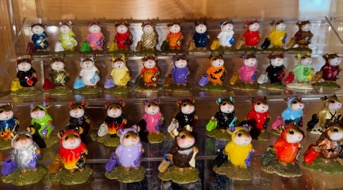
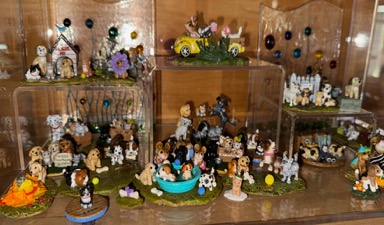
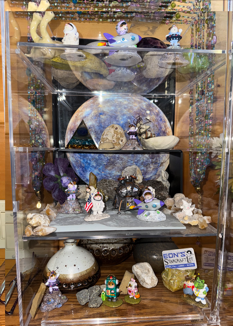
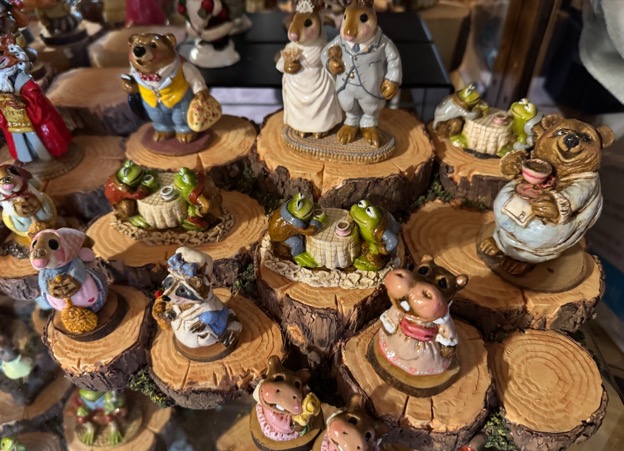
Types of collectors are described in the pages that follow, along with strategies for finding the pieces and displaying them to best advantage for each collecting strategy. Display photos of actual collections are provided at the end of the essay.
COMPLETISTS
Completists come in two somewhat overlapping forms: Total Completists and Piece-Specific Completists. For both groups, "having them all" is the goal.
Total Completists want at least one of every WFF piece in the WFF line: all the mice, all the animals, all the birds and bunnies and scenes and all the accessories but not necessarily multiple colors or variations of any one piece (those can always be added later). A Total Completist's dream is to acquire all the new pieces as they are announced but also to fill in the collection by tracking down the elusive pieces from years ago such as Cave Mice, Beauty and the Beast, Nutsy Squirrel, the Leprechauns, Farmer Mouse, Wood Sprites, Bride Mouse, Professor Rabbit, and the Concordian Mice (among others). They want a check mark after every possible piece in the Master List indicating that those pieces are in their collection. Even one missing WFF is a reason to keep searching….and searching….and searching.
This type is a disappearing collector group due to the numbers of pieces that have been added to the WFF line since Annette sold her first WFFs in person to local gift shops in Massachusetts and Maine. If one includes event specials, store specials, animals, factory gifts, customized pieces, and accessories, the total number of pieces is in the thousands. Moreover, many of the "special" and "limited" pieces are in short supply, as are the older pieces that were sold in very small numbers and that may have quietly disappeared over the years.
Still, searching for the difficult-to-find pieces can add significant motivation for collectors. And the availability of social media sites such as the WFF Wee Trading Post™ and the Wee Forest Folk Collectors' Club Facebook pages, the WFFCC Marketplace on the Club website (www.weeforestfolkclub.org), sale sites like ebay and Amazon, and WFF retailers who maintain large numbers of current pieces and also take rare and retired pieces on consignment make collecting from home easier than it was back in the days when collectors called shops all over the country to find pieces.
Of course, the hunt can be part of the fun, as can bartering, trading, or buying pieces from fellow collectors and even working together to help each other find what they need. In fact, many close friendships have formed and prospered among WFF collectors who socialize with other collectors and, in so doing, help each other locate the elusive pieces. Needing "one of everything" is a super-ambitious goal and having a support team in place can make the hunt more fun.
Rather than wanting one of every piece, Piece-Specific Completists want every available variation of specific pieces such as Zeldas or Little Devils or Sunday Drivers, a smaller but probably equally challenging goal, especially if the goal is to collect one of everything for several different pieces. Whereas Total Completists tend to be happy searching for one of each piece, Piece-Specific Completists want to find ALL variations of the pieces they collect, including multiple colors, event pieces, gift pieces, embellishments, customizations, and even mistake pieces and minis. The search is exhausting because not all of these pieces appear in catalogs or on ebay or other secondary market sites and so there is always anxiety over whether or not the lists they make of what they "need" include all of the possibilities. Regular line pieces frequently exist in significant numbers of different colors and designs. For example, at last count Zelda has been discovered painted in over 50 variations, and that may not be the total number.
Knowing when to quit can be a guessing game.
For example, consider a Piece-Specific Collector who wanted all of the Mousey Pianist variations back in the days when there were no color Master List photos or sites online to guide that search. That collector may have originally found a Mouse Pianist at a store somewhere dressed in pink sitting behind a piano mostly decorated in blue on a blue cloth rug with a ceramic base. Thus, a reasonable expectation might have been that the key variables for that piece are dress color, piano decoration color, and rug color. It might take some time to realize there are many more variables to consider: Pipe-cleaner tail or leather tail? Or no tail? Ceramic base or some natural base like a varnished tree branch slice or a smooth stone (with or without pink or blue cloth rugs)? Pink dress with blue ribbon or blue dress with pink ribbon? Or pink shirt with white skirt and pink or blue ribbon? Then there is the piano to consider: bright pink or pale pink decoration or some combination of pink and blue or all blue or all pink? And then there is the matter of the Violinist piece that was available either alone on its own base OR on a base shared with the Pianist. Would the Completist want all pianos alone on the bases? Or should at least two of the pieces contain a Violinist, one in blue and one in rust pants? But what if those colors more than simply doubled the number of pieces needed because every version of the piano alone might be offered with either a Violinist in blue or one in rust pants? What if there is a third color for the pants that hasn't been discovered yet???? And how would the Collector begin the search? Stores were distributed across the country, thousands of miles apart, so visiting them all would not be possible for most collectors. Long-distance phone calls to all of them? How many shop owners/employees would be willing to create a list of all the variations they have for sale in their cases? How many shop owners back then would have realized Mousey Pianist was available in multiple color combinations? It could take years to locate all of the possible variations for just those two pieces (Pianist and Violinist) and there would have been no way to be certain no variation had been missed.
Finally, a subset of the Piece-Specific Completists are the collectors who can't settle for partial "sets" of pieces such as the Christmas Pageant, the Marching Band, the Scrimshaw mice, the Winter Carnival, the Fall Festival, Alice in Wonderland, the Fairy Tales Peter Pan set, and the Nutcracker set. Even if these Piece-Specific Completists prefer some pieces in a set to others (and maybe even when they actually don't care for one or more of the pieces in the set), they "must" have every piece in that set because anything less than ALL of the pieces in a set makes the set incomplete. And "incomplete" is never the goal for Completists.
Sometimes wanting all of the set pieces means waiting months or years for a set to be completed, as happens with pieces like the seasonal pick-up trucks and pieces that are added over a span of months (or even years) to create a set like the Christmas trains and the Caroler Family.
Total Completists would have had a difficult time in the early years when Annette Petersen, the founder of Wee Forest Folk, was experimenting with pieces, sizes, colors, and so on by offering them to shop owners in a variety of colors, configurations, and sizes before officially creating a "line" of pieces for sale. No doubt some pieces exist that have never appeared in a WFF piece list or catalog. And other pieces morphed through a variety of forms, bases, and colors before entering the WFF line. Because there was no internet and the only way to see and/or buy WFFs was by visiting a shop that carried them, the search for "one of each" would have been exhausting, and probably the goal of having them all was beyond reach because, once again, there was no way to know when all the pieces had been located.
Total Completists probably benefited most from the eighties and nineties (and beyond), when pieces were numbered, catalogs and purchase lists were distributed to WFF vendors and collectors, and the yearly catalogs provided a specific list of pieces in the line. By using some form of a spreadsheet, collectors could keep track of pieces in their collections and create a fairly accurate list of the pieces still needed.
Later, when computer communication and searches were possible, the WFF website posted a list of shops selling WFFs complete with addresses, phone numbers and sometimes even email addresses and website URLs. The WFFCC newsletter (Folktales) announced retirements and new pieces and offered both an AUCTION and a FOR SALE feature in the newsletter and on an early form of social media called the WFFCC Bulletin Boards. Creative Hands, a shop in Lombard, Illinois, posted copies of WFF catalogs on their store website (these are also now available on the WFFCC website) so that everyone who incorporated the World Wide Web in their collecting toolbox would have access to piece lists twenty-four hours a day. Collecting did not require leaving the house if one had a computer, a landline, and AOL.
Later, forming into search support groups made the search even more doable. For example, roughly 20 years ago the Mouse Factory provided store specials for about 100 retailers in the same year, which caused both high excitement and maybe even higher anxiety for Total Completist collectors. That year many coalitions were formed and collectors worked within their groups to locate the stores and the pieces available at each shop and shared that information with their teammates . That was probably the year we all realized that sometimes it takes a small army to be a Completist.
Of course, as the collection options began to grow, purchasing a piece in every color and configuration became even more challenging because there were multiple ways pieces were crafted and sold. WFF events (Folktoberfest, Mouse Expo and Fairy Tales) often sold or gave away pieces available only to attendees at those events and those pieces did not appear in the catalogs (but they were listed in early versions of the WFFCC Master List and on brochures used to advertise the events). Some event pieces were differentiated from the regular line pieces because they were decorated with personalized embellishments, used bases different from the "standard" base shown in the annual WFF catalogs, and were painted in unique color combinations. However, in most cases, event pieces were completely new designs created just for that event and never available in the WFF regular line. Moreover, shops that carried WFF pieces often had "store specials" that typically were available in limited quantities and not widely advertised because the purpose of store specials was to introduce that store to collectors and encourage collectors to make the trip to visit in person.
By this point in time, most collectors had developed other (different or additional) collecting strategies, whether they realized it or not. And collectors routinely began forming teams and coalitions to help fellow completists find what they needed. Wee Forest Folk collectors started to become a community rather than random small groups of WFF friends.
In spite of the literally thousands of WFF pieces that have been created, being a Total Completist is still very much in style. But being one demands a LOT of display and storage space (some collectors have filled entire rooms with cabinets containing Wee Forest Folk items) and usually involves a spreadsheet or an online inventory like those on the WFFCC web page to keep track of the collection. On the bright side, Total Completists are constantly busy engaging in the search. They check Ebay and other online sale sites regularly. They travel to distant cities to meet with other collectors and visit shops they have never visited before that sell WFFs. They scrutinize photos on social media pages (including displays posted on the Wee Forest Folk Collectors' Club Facebook page), looking for pieces they may have missed. They socialize in person and online and they travel to Carlisle to meet the family who created this wonderful collection. In short, the search process adds to the excitement and searching for pieces sets the pace and goals for a lot of travel while making lasting friendships along the way!
Of course, being either a Total Completist or a Piece-Specific Completist affects the ways these collectors display their collections. Due to the comprehensive nature of a Total Completist collection, the pieces are frequently displayed as one might find them in a museum: in long rows of pieces in numerical order or grouped by year or decade of creation; in separate cabinets or on separate shelves for Annette, Donna, and Willy pieces; or grouped by themes (holidays, seasons, occupations, etc.).
Piece-Specific Collectors tend to display all variations of a given piece together to highlight the similarities and differences among them. A curio shelf loaded with over 50 Little Devils or April Showers pieces or Mousey's Bake Sales is a COLLECTION by itself. And there is no shortage of pieces for these collectors to acquire and display. Scores of WFF pieces have been painted in a variety of colors and embellished or customized/personalized in multiple ways. Consider, for example, the following pieces: Pedal Planes, Zeldas, Mousey's Bunny Slippers, Pedal Pushers, Joe D'Mousio/Batter Up! ballplayers, Greetings!, Sunday Drivers, and Yummys. All are regular line pieces, most of them come in more than one color or design in the regular line, and all have been altered in multiple ways not shown in the catalogs: color changes, customizations, embellishments, store specials, event specials, and factory personalized gifts. With the help of online retailers and the secondary market, it is possible to achieve a very high completion rate for these pieces and also possible to add more as one-of-a-kind pieces are offered for sale.
In short, Completists of both types are the searchers and researchers of Wee Forest Folk collectors because they are almost always missing one or more pieces they need to complete their collection and sometimes they find pieces that have never been documented anywhere. Completists don't get to take a break until a piece retires because only then can they be at least somewhat hopeful they know which pieces or variations of the pieces they need to find to have them all.
COLOR COLLECTORS
At some point WFF collectors began making choices about what they like best about WFF pieces and ways to incorporate those choices into their collections. An obvious choice was paint color.
Early on Annette worked predominately in three colors: pink, blue, and (to a lesser extent) yellow. Most pieces could be found in some version of pink and/or blue with other trim colors. However, by the mid-1990s, collectors began asking for specific colors. In particular, various shades and hues of purple became incredibly popular, as did the red/white/blue combination. (In fact, for a while this author collected all the pieces that were painted with a purple/lavender color option—a group of pieces large enough to fill its own shelf in a curio cabinet).
Many other collectors (and event planners) also began asking the factory for color changes: brighter colors, fall colors, spring colors, etc. The Petersens were happy to add more colors to the line and they were able to create their own versions of shades, tones, and hues of all primary and secondary colors by mixing their own paints. At last count by this author, WFF paint colors number well over 100 and every color has a unique WFF name. According to a recent Sherwin-Williams print ad for their paint color inventory there are over 160 named colors in their palate for shades/hues/tones of just the color "blue", suggesting that collecting by color could eventually result in hundreds of WFF pieces that fit in a preferred color scheme.
Holidays have frequently been a reason for the Petersens to create pieces in a variety of recognizable colors. For example, Halloween pieces tend to be painted in "Halloween Colors" such as black, orange, neon green, and purple. Christmas pieces tend to follow a red, green, white, and gold color scheme. Other holidays tend to have established color schemes as well. New Year's Day is generally linked with sparkly paints and bright colors. Valentine's Day is portrayed in pinks, reds, white, and gold. St. Patrick's Day immediately suggests the color green accented with gold and white. Easter colors are pastels. The 4th of July is almost always displayed in red, white, and blue, and Thanksgiving colors are fall colors: red, orange, yellow, and brown. Color collectors like to put together any and all WFF pieces to create scenes in their preferred colors. Purple collectors, for example, will find a broad range of WFF of pieces wearing purple from Night Prayers with purple bedspreads to Expo's purple Pedal Plane to a lavender Pedal Pusher. A Halloween scene might feature witches with black gowns and purple accessories surrounded with jack-o-lanterns in black and orange. A family scene might be comprised of all family members dressed in different shades, hues, and tones of purple. Only Batter Up! pieces wearing purple uniforms may be allowed to take to the field, and so on.
In short, color preference might be a determinant for choosing which WFF pieces to purchase and how to display them. As alluded to above, Batter Up! pieces come in a wide range of color choices. Red/white/blue lovers will find it easy to create Major League Baseball teams in their favorite colors: Boston Red Socks, Chicago Cubs, Texas Rangers, Atlanta Braves, Los Angeles Angels, NY Mets, Philadelphia Phillies, and Toronto Blue Jays all wear or have worn red/white/blue uniforms at some point in time. However, purple lovers will have to put Colorado Rockies ball players on BOTH sides of the game because only one team wears purple.
SCENE DEVELOPERS AND SET BUILDERS
About a third of the collectors who completed the survey indicated that they like to purchase pieces that "fit together in scenes" because they enjoy telling a story with their WFFs. Many of these scenes start with groupings of mice the Petersens have designated as "sets", such as the Christmas Carol pieces, the Twelve Days of Christmas, Scrimshaw pieces, Christmas Pageant, Caroler Family, Alice in Wonderland, the Fairy Tales Wizard of Oz pieces, the Mouse Expo pirate pieces, the Folktoberfest Hippie Collection, Winter Carnival, Fall Festival, Cinderella, and the Snowball Fight, to name a few. These sets suggest scenes based on where collectors have encountered similar scenes in the media or in real life. Scene developers also group pieces in ways that suggest other types of scenes they have encountered: groups of skiers or skaters in a winter scene, beach lovers swimming and floating and taking in the sunshine in summer scenes, etc.
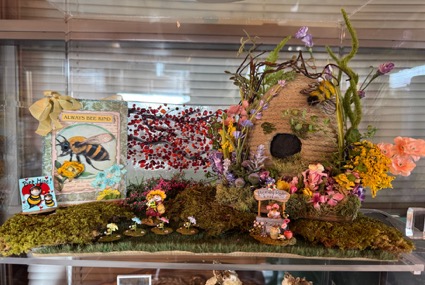
But gathering WFF pieces together is just the beginning for Scene Developers. Their WFF pieces usually benefit from the addition of other elements to help develop the scene and, as a result, Set Builders need a variety of backdrops and props to create displays that appropriately accessorize their scenes.
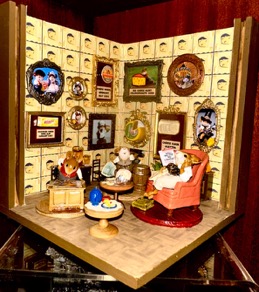
In the survey, WFF Collectors indicated that scenes are frequently developed around commercially available or handmade display items that help to create the larger setting, such as shelf-sitter storefronts, displays that feature sand and water to create beaches, trees and benches that create parks and playgrounds, outdoor items covered in snow, ponds, pirate ships, castles, moonscapes, and so on. Many sets of pieces have deliberately been created by the WFF company and by individual shop owners to help collectors put together groupings that suggest action and tell a story. For example, a WFF seller just announced they have started selling a line of do-it-yourself "rooms" that make perfect backdrops for Wee Forest Folk pieces. Another shop carries a line of painted pewter backdrops appropriately sized for most WFF that add interest to WFF scenes. Still others stock other collectibles that are compatible with Wee Forest Folk and/or display items created specifically for Wee Forest Folk.
Some display items are large and detailed whereas others are smaller and simpler. And many artists have provided display items that fit beautifully with the sets described above as well as small groupings of WFFs. Creations by Rhoda and Barb (sadly, no longer available except on the secondary market), Dorothy Sawyer, Carolee Clark, Nancy Malay, and other artists are now creating or have in the past created display items at a scale that works perfectly for WFF scenes. Other display items are borrowed from other collections (e.g. Jim Shore, Mary's Moo Moos, Department 56, Hallmark ornaments, Habitat Hideaway) or found on websites like Etsy and ebay. In addition, WFF collectors often attend miniature shows where they find handmade minis crafted to the perfect scale for WFF displays.
All it takes is a little imagination (and a bit of traveling in person or via the internet) to put together the "perfect" displays for many types of WFF scenes.
Pictured at the end of this essay are some examples of scenes that can be created using Wee Forest Folk along with display items to create visual representations of WFFs going about their lives (e.g., shopping, cooking, camping, swimming, playing seasonal sports, going to school, trick-or-treating and celebrating holidays). There are also larger scenes that incorporate a variety of elements that contribute to a larger scene (e.g., castles, fairy villages, a circus/carnival, outer space, and Wizard of Oz items including rainbows and a yellow brick road. There is even a Cheshire cat on a brick wall made by WFF for their Alice in Wonderland set.
SCRAPBOOKERS
Many of us have created scrapbooks of one kind or another to save memories. Remember the massive scrapbooking boom of the 80s and 90s? Back then the materials used were fancy paper pages, photographs, newspaper clippings, cards and letters, cutouts, banners and so on. Many scrapbookers spent entire weekends at scrapbooking retreats as a form of vacation activity. Entire sections of craft stores were devoted to selling scrapbook materials.
According to participants in the survey, WFF Scrapbookers tend to purchase WFF pieces as markers of significant events in their lives: places they have visited, friends they have made, family celebrations, family member experiences, work experiences, milestones, vacations, accomplishments, and other memories. Each event in the collector's life may create a reason to seek out the perfect WFF piece or pieces to represent that activity: store specials from every WFF dealer visited, pieces that represent experiences (beach scenes, camping scenes, snowball fights, train rides, weddings, and graduations), pieces that represent hobbies or favorite pass-times (sports, movies, birthday parties), and so on. Instead of pages to turn to evoke memories of past events, Scrapbooking Collectors have their displays to enjoy.
The forms the WFF "scrapbooks" take can vary significantly on display. These pieces, if small enough in number, can be displayed as "sections" of a curio shelf devoted to specific life events: a gathering of skiers on a "snowy" platform representing a special ski trip, the Creative Hands store special School Days pieces set in front of a commercially-made schoolroom backdrop to celebrate academic milestones or their Zoo set to remember a special trip to see Pandas. These WFF "memory makers" may take up an entire shelf in a curio or may be small enough to be set up in cloches or under glass cake covers to isolate extra-special memories. Large experiences such as travel memories, vacations, and/or family holidays or celebrations might take up several shelves in a cabinet and may also contain a range of accessories and display items to better set the scene. A trip to Mackinac Island in Lake Michigan might be represented by a shelf sitter painted as a fudge shop, a souvenir statue of the Mackinac Bridge, WFF mice eating ice cream (or fudge) all sitting on a human-sized sweatshirt embossed with the words "I double-crossed the Mackinac Bridge" that sets the scene for the "scrapbook" page.
Scrapbooking Collectors might also create displays tracking life events for individual family members: Graduate Mouse in green and white might represent graduation from Michigan State; one of the Chef pieces might represent Dad's prowess with the backyard grill; Fishin' Chip might represent that trip to Alaska to fish for wild salmon; Meadow Muses might represent a trip to art museums in Europe; and the Mother Goose (from Mouse Expo) might represent all the books shared with the children when they were young. The possibilities are as numerous as the volume of memories and lived-experiences collected.
Scrapbook WFF collections never achieve closure because they represent the major events and everyday tasks that make memories. As long as Scrapbook collectors continue to add experiences, the potential for adding more WFFs to attach to those experiences will be there.
DOLLHOUSERS
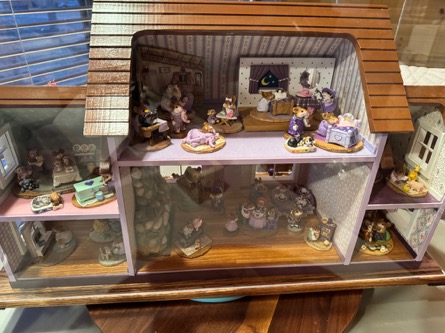
Sometimes WFF pieces don't just sit on a shelf and look adorable. Instead, they stand in for residents of that dollhouse we always wanted as a child but never actually had a chance to play with. Now, as adults, we can create the experience of having a dollhouse with Wee Forest pieces while behaving as adults, not young children. By buying miniatures in the proper scale for the pieces we've collected and either building or buying "houses" that serve as dollhouses, WFF collectors can relive the pleasures of having had a dollhouse or, conversely, create those "memories" a few decades later.
Dollhouse scenes are very easy to create by purchasing dollhouse miniatures, which can be purchased in a scale appropriate for most WFFs. And those miniatures can serve a variety of functions. They can be casual representations of the pets we had, the kind of house we lived in, and the everyday things that have made up our lives: cars, carriages, inflatable swimming pools, plants, food, art, sports, outdoor friends like bunnies and raccoons and birds, and on and on and on. Or, they can represent the things we're doing now or even the future we'd like to create someday.
Fortunately, there are numerous WFF pieces that can be used as the residents of those dollhouses: scores of trick-or-treaters to use with a witch's house; swimmers and tubers and surfers and sand castle/sand creature makers for a beach house. Numerous family mice watching TV, eating, bathing children, sleeping, flying kites, hula-hooping, riding tricycles, etc. can be used to fill the house and yard with activity. Those WFF pieces can represent the everyday activities that make up a collector's lived experiences.
What makes this type of collector different from the others is a willingness to "play" with the pieces, to change the scenes at will, to surround the pieces with display items like kite trees, flowerbeds filled with daisies, and antique cars in the garage that maybe only make sense to the dollhouse owner. To these collectors WFF pieces are not meant to stand in long lines by piece number or to sit on shelves with other pieces that happen to have been painted in the same colors or stand in static scenes that never change. But, of course, the risk of being a Dollhouser is real. Wee Forest Folk do NOT bounce if dropped, even on carpeted floors.
Again, the possibilities are as varied as the search a collector is willing to make to find the "right" pieces to go with the house. Even Annette built herself a dollhouse as an adult, although we don't know if she ever populated it with her WFF friends.
HOLIDAY LOVERS/SPECIAL OCCASION DECORATORS
WFF collectors in this final category of collector type are the WFF collectors who wait with anticipation every year to see the new holiday pieces: New Year's Day, Valentine's Day, St. Patrick's Day, Easter, Mother's Day, Flag Day, Father's Day, 4th of July, Halloween, Thanksgiving, Christmas, and maybe even "holidays" not on the calendars like Birthdays, Anniversaries, and Graduations. These collectors LOVE "the holidays" and they love decorating for holidays and other special occasions.
If you search the WFF website for available pieces you can literally sort by Seasons and Holidays, making it super-easy to find pieces that fit into the Holiday Lovers category and create Scrapbook-worthy displays to commemorate those occasions.
However, these collectors frequently keep large numbers of their WFF pieces packed away, waiting for their special holidays like Thanksgiving when they come out to serve as decorations across the fireplace surrounded by gourds and straw flowers, or Christmas when the Christmas ornaments are hung on a small centerpiece tree on the dining room table and Christmas trains run on tracks in the center of the buffet. When the special holiday is over, the pieces associated with that holiday go back into storage or into curios to wait until their special occasion rolls around again next year.
BUT WAIT! THERE IS MORE!
Our description of Types of Collectors and ways to display WFF collections does not end here.
Collector Types described in this essay relate to a frozen time over 20 years ago. Would the respondents for that survey answer the questions now the way they answered them then? Probably not.
For humans, passing time changes everything: family composition, available resources (health, family, finances, etc.), age-related interests, hobbies and recreational pursuits, technologies, friendship groups, personal capabilities, and on and on and on. Each of those variables has the potential to change how Collectors curate their collections.
Most, if not all, current Wee Forest Folk collectors recognize the impossibility of being a Completist of either variety. Not even the Petersens themselves own one of everything.
Perhaps some very very wealthy collector could hire personal assistants to search the world for WFF pieces, but it seems like it would take the small army mentioned earlier to even begin to achieve such a lofty goal.
There are still Completists among us but they have probably redefined what it means to be "complete": all of the regular line pieces as pictured in the catalogs for some specific set of years? all of the Annette pieces that wear hats? all of the pieces from a favorite WFF event? all of the WFF factory-released pieces offered in the years the grandchildren were born?
The nature of the goal and the length of time associated with making something "complete" can be altered to fit new circumstances.
Color collections are reasonable if the collector also sets some parameters to keep the goal more reachable: All of the purple beach pieces? All of the purple pieces from the year we lived in Massachusetts? All of the purple vehicles?
Scene Builders probably find it even easier to build scenes now than they did in the 1980s. There is no shortage of items in a WFF scale in the various marketplaces. Likewise Set Builders just need to be financially able to purchase full sets. The Petersens do a wonderful job of creating sets inside the regular line.
Unless Scrapbookers are hoping to find ways to represent truly exotic memories such as that week we spent as contestants on a cooking show, or that trip we took on a SpaceX rocket, or the year living in a cave in the Rockies, Scrapbookers should be able to find appropriate items to set the scenes.
Likewise, for the Dollhouse Collectors, any type of dollhouse can be designed and built and there are no quotas to be met and no specific, elusive WFFs to find to live inside.
In fact, finding WFFs that fit inside the theme of almost any dollhouse should be doable, as should finding the WFF dragons or robots or time-travelers or ghosts to establish the scene.
And Holidays are literally celebrated with hundreds of WFF pieces in the regular line, and thousands of display items are available that could help to fill a curio shelf to celebrate each and every one.
CONCLUSION
By now you've probably decided which, if any, of these categories of collectors best describes you. Or, at the very least, hopefully this essay has made you think about how to display pieces from your WFF collection.
The last section in this essay presents photographs of how each type of collector might create displays based on the numbers and types of pieces they have collected or hope to collect. The displays presented are actual displays created by WFF collectors. The examples will hopefully provide inspiration for ways you already "collect" and way you might display those pieces based on that collecting style.
QUIZ: See if you can identify which Collector Types created each of the displays below. And see if you can USE this information elsewhere by taking a careful look at the displays presented for the contest displays on the WFFCC Facebook pages and trying to determine the types of collectors who submitted photos of their displays. Even better….what do your displays say about how YOU collect???