One-of-a-Kind
(OAK or sometimes OOAK) Wee Forest Folk®
Scarcity
and uniqueness are considered components of perceived value for
visual art, automobiles, precious metals, glassware, and scores of
other types of collectibles. Wee Forest Folk can be considered
scarce and/or unique in a variety of ways because they are
hand-sculpted, hand-designed, hand-painted, and often offered for a
limited time and/or in limited quantities. Thus, one of the main
ways WFFs are often considered 'special' is when they have been
created as one-of-a-kind pieces that are both scarce and unique.
Online
sellers such as eBay and Amazon sometimes offer WFF pieces for sale
that you won't find in this Master List. They might resemble
pieces in the line but they have been modified in some way that makes
them different from the catalog pieces.
Hundreds
(or, more likely, thousands) of WFF pieces have been made that can be
considered one-of-a-kind. No other piece exists that is exactly the
same as these special pieces, and there are multiple ways for a WFF
piece to become an OAK. For collectors, being able to differentiate
among types of OAK pieces is important for understanding just how
special a WFF piece really is.
There
are at least six ways legitimate WFF pieces may become a bona
fide
one-of-a-kind:
UNDISPUTED
OAKs:
when a piece is the only
sculpture of its kind
(totally different in every way from every other piece created by
WFF), such as prototypes that never officially enter the line or
specially crafted sculptures that become gift or auction pieces,
never to be repeated;
MODIFIED
OAKs:
when the greenware for a WFF piece is modified
from its original form in some significant way,
such as when a facial expression is changed or hands are doing
something different or the body posture has been changed, and the
resultant sculpture is painted in unique colors for just one piece;
CUT-AND-PASTE
OAKs:
when a WFF
is changed in significant ways
by changing elements of a piece such as different mice, birds,
landscape features and/or mice and by painting those elements in new
colors, but only for one piece. It's also a CUT-AND-PASTE when
multiple mice and other elements are put together in unique ways and
painted differently from the originals and this combination is made
for just one piece and never repeated;
COLOR
CHANGE OAKs:
when the greenware is exactly the same as the regular line WFF
pieces but the painting on the piece is different and applied to
just one piece;
CUSTOMIZATION
AND/OR EMBELLISHMENT OAKs:
when a
piece is customized in unique ways by
either the WFF factory or by collectors at a WFF-associated
customization event with no two pieces turning out exactly the same,
the results are customized OAKs; and
MISTAKE
PIECE OAKs:
when a
WFF accidentally becomes an OAK
because some aspect of
the piece is different from every other piece (embellished or
personalized in a way not repeated on any other piece) by either
accident (the wrong paint color on a detail or missing paint or
someone forgot to glue on an accessory or located the accessory in
the wrong place) or omission (something has been left off that every
other piece has).
In
short, the key to being considered an OAK is the fact there is no
other piece exactly like it and there never will be another one. Of
course, the more individualized and unique the piece, the stronger
the claim can be made that it is (and will continue to be) an OAK.
In
the interest of creating consistency in how secondary market terms
are used to describe Wee Forest Folk pieces, this essay will present
definitions for various 'levels' of specialness one might find
when collecting Wee Forest Folk and photographic examples for each of
those levels from actual Wee Forest Folk creations. It should be
noted, however, that actual WFFs may not have evolved in ways that
totally conform to one category. The WFF line grew and evolved; it
did not follow a blueprint or master plan. True art never does.
And
it should be noted that the listing used here is not meant to suggest
an ordering by value. 'Value' is a perceived construct, not a
rule-governed perception. Some collectors seek out mistake pieces as
their preferred OAKs, whereas other collectors prefer to take
advantage of customization activities or search for color changes as
ways to obtain one-of-a-kind pieces.
ONE-OF-A-KIND
LEVEL ONE UNDISPUTED OAKS—the only piece that looks like this in
existence
Calling
a WFF piece an UNDISPUTED one-of-a-kind means no other sculpture
exists with the exact elements used to create the piece in question.
It is a totally original work that has never been replicated in form
or decoration. Not even once.
Please
note, however, that this distinction puts a WFF piece in a class
entirely by itself, but it does not guarantee value because being
singular doesn't necessarily make a piece desirable. Many other
variables influence perceived value, and perceptions differ
significantly from one collector to another.
Probably
the most special and unique of all the OAKs in the Master List is
called simply Early Mouse, EA-1. It has never been replicated, nor
will it ever be. According to the Petersens (from personal
conversations), this is the first mouse piece Annette Petersen
sculpted, fashioning it from bread dough after carefully studying a
real (dead) mouse for several days. It has the ears and the eyes and
maybe even the nose of later WFF mice, but it is resting on the bark
base, not sitting or standing; it is unclothed and unpainted; and it
has a really long pipe-cleaner tail. The owners of this piece (Donna
and Willy Petersen) have the only EA-1 in existence and the chances
of it being replicated are zero.
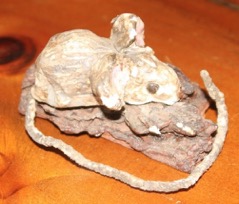
Prototype
OAK Mouse Made from Bread Dough
In
this case, the value of the piece is based on its significance for
WFF® as a company and Annette Petersen as an artist and
entrepreneur. For those reasons, it's priceless. But, sitting on
a shelf in an antique store or listed on ebay with no provenance, it
wouldn't sell for much, if at all, ever.
There
is, no doubt, some number of OAK pieces from the very first days of
Annette's work as a sculptor that never will surface in public. It
is fairly common knowledge that she created (and often only partially
finished) numerous pieces that never made it into the actual 'line'
of WFFs for sale as she worked out the details for how she wanted a
specific piece to look. Sometimes it was a case of moving a shopping
basket from one side of the piece to the other or changing the bow on
the hat or adding/subtracting accessories to a piece. Other times a
piece might have changed from two mice holding a broom to two bunnies
sitting on a stool. By definition, those early prototypes, probably
long gone, were OAKs. And many gradually evolved into the pieces
that are listed for sale in the earliest promotional material for the
WFF line.
One
mouse that appears to have gone through several prototypes before
being retired entirely is Wood Sprite. In the very earliest catalog
of pieces dated 1978 (see https://weeforestfolkclub.org/catalog/),
Wood Sprites appear in three forms: a, b, and c. In version a, her
hands are out to the sides, she is holding a flower in her left hand
and she is facing one side of the leaf under her mostly invisible
feet. In version b she is holding the flower between her hands out
in front of her, there is more definition to her face and her eyes
are larger, and she is once again facing the side of the leaf. In
version c, her hands are up to her face and she is looking upward,
not straight ahead.
Two
pieces have been located (and included in this Master List) that are
almost certainly early prototypes for the three versions that
ultimately made it to market. Both have a different orientation on
the leaf from the three 'official' versions and both have hands
that hang down, empty. Both appear to have elements of one or more
of the three versions offered in 1978 (ears, head position, body
shape, leaf base, large eyes, simple mouth expression) but neither
one is an exact match. Both are considered UNDISPUTED OAKs.
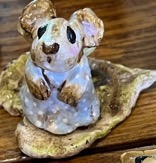
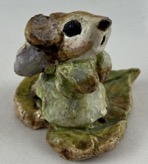
Prototype
Wood Sprite OAKs
Other
versions of Wood Sprite in this ML suggest several prototypes were
created before Wood Sprite actually entered the WFF line-up. The
versions below are all slightly different. If we assume the Mini
version (pictured below) is a tiny reproduction of an actual finished
version of a regular line Wood Sprite, can you tell which of the
possible Sprites shown below probably served as the model for that
piece?
 Mini
Wood Sprite
Mini
Wood Sprite
Can
you tell which of the pieces below are versions a, b, and c described
above?
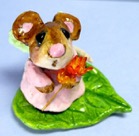
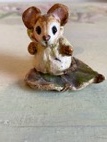
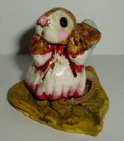
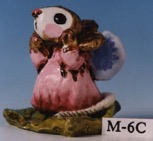
Various
examples of Very Early Wood Sprites
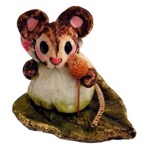
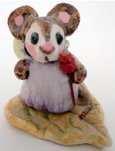
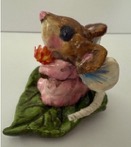
Given
that all of these mice were hand-sculpted, hand-painted (there were
no designated color combinations or specified colors for them), and
hand-finished (note that some have white pipe cleaner tails and some
have thin leather tails), it's reasonable to assume that no two
pieces were exactly alike in 1978.
Another
mouse that may or may not be a true OAK is called Miss Neighborly
Mouse in the Master List. It has no known ID number and is listed under the fabricated number
M-000b. It does not appear in any of the early literature and/or piece
lists that have been located to date.
Two
possible prototypes are pictured in this Master List. The clothing
is different between these two pieces, one
has an apron pocket and the other doesn't, and tilt of her head is
slightly different. This piece is considerably larger than most mice
created in her presumed timeframe (note the tiny mouse that was
constructed in approximately the same timeframe in the corner of the
first photo).
Nonetheless
Miss Neighborly Mouse is clearly an Annette Petersen creation and is,
no doubt, considered extremely valuable by her current owner(s).
Quite possibly owners of both the Neighborly Mouse in red and
yellow(?) and the one in red and white would (and probably should)
argue that their pieces are one-of-a-kind, even if there are only
slight differences between them.
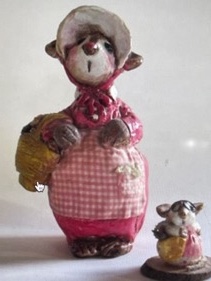
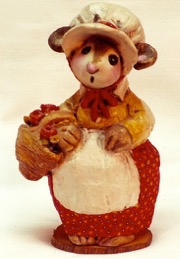
Miss
Neighborly Mouse in two versions
LEP-1,
the male Leprechauns, also illustrate some
of the issues with so-called UNDISPUTED OAKs just discussed.
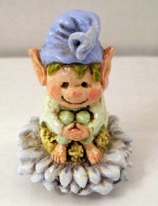
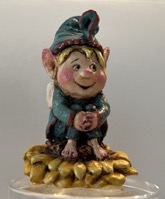
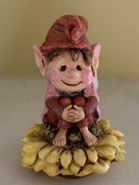
Three
Different Male Leprechauns—OAKs?
The
one on the far left was made public first and its owner was certain
he had been given the only version of this very special piece in
existence, a True and Undisputable One-of-a-Kind. However, that
turned out not to be the case. Two more variations have since been
identified, as shown in the photos above. Not only that, female
Leprechauns have also been discovered and added to the Master List!
The WFF collection continues to grow from the addition of new pieces
AND the discovery of very old pieces which complicates the search for
'all' of the OAKs.
While
all three of the male Leprechauns have many similarities, each one is
different from the others. The boy in blue and the one in maroon
have black dots for eyes, as do the vast majority of WFF mice. The
blue hat appears to be somewhat larger than the maroon and green hats
(although this difference might be related to the fact the figure is
leaning a bit more forward than the other two), and his clasped hands
seem to be just a little smaller and less defined than the red-hatted
piece. The boy in green and red is different from the other two in
several ways. His hat is decorated with maroon dots and his clothing
is enhanced with maroon bands. His fingers are less detailed, as are
his toes. Perhaps the biggest differences are on his face. He has
eyes and eyebrows! And very pink cheeks. And a wider, more defined
smile. His hair and the petals on the base appear to be gold and the
entire sculpture appears to be attached with a whiteish glue to a
clear pedestal. Neither of the other two pieces have pedestals.
Finally, the green jacket has sleeves and cuffs, the pale green
jacket may be slightly different, and the maroon outfit has a pink
jacket with short sleeves.
So...questions
you may want to ask yourself: are these all LEP-1 variations of the
same piece or is the one in the middle too different? Do the
differences make each one an UNDISPUTED OAK in their own right? Or
are they all the same piece finished in different ways, making each
one a variation of the same Leprechaun? Do the distinctions really
matter with pieces this rare?
It's
very likely that more prototype pieces will continue to be revealed
as more time passes. Sale sites such as eBay and Amazon create
awareness for collectors that can lead to discoveries that otherwise
might never be made. When a person discovers that the very old mouse
sitting on a shelf in the spare bedroom is, in fact, a sculpture
someone else would consider a treasure, that old mouse is often
listed for sale.
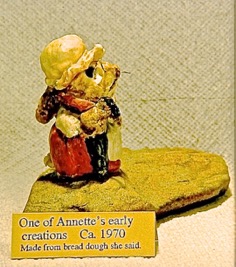
Consider,
for example, the piece pictured below. It's difficult
to tell from this photo, but the owner claims it is another piece
that was made from bread dough in the 60s. Given that we don't
have much information about this mouse, it's likely that clay
versions of her are in homes in New England waiting to be discovered.
The transition away from bread dough would be the first thing that
makes this piece special, as well as the pieces that may or may not
have followed between Annette's construction of Lady Mouse with
Basket (for lack of a better name) and other older mice in the line.
Were there other prototypes between this piece and other lady mice
with bonnet hats and umbrellas? Time will tell.
Finally,
there are several OAKs 'out there' that were given as gifts or
prizes over the years that started as the same basic piece. One
unfinished piece of whiteware (pictured below) was a gift from the
WFF factory at two (and possibly 3) of the events (Fairy Tales,
Folktoberfest, and possibly Mouse Expo). The lucky winners were
given the opportunity to work with an official WFF painter to have
the piece finished to his/her specifications (clothing style and
colors, types of cupcakes (or maybe even something other than
cupcakes), paint colors for base items, etc.), and the promise made
was that the piece would be unique and never replicated and/or
entered into the WFF line. This author has never seen one of the
finished pieces.
Even
if three of these whiteware pieces exist in form, having a unique
piece that literally was never in the line, has no factory-assigned
WFF number, and was painted to the owner's exact specifications (or
not in conversations with a Wee Forest Folk painter/designer would
probably qualify as an UNDISPUTED OAK for most collectors.
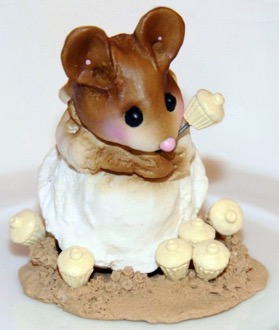
Unfinished
Mouse 'prize' at WFF Events
ONE-OF-A-KIND
LEVEL TWO MODIFIED OAKS—unique pieces created by changing the
greenware and/or accessories used for an existing piece
WFF
pieces that fit into this category are probably limited in number and
frequently are created to be OAK gifts, charity auction donations, or
prizes. A mouse in the WFF line can be used as an example of how
greenware and/or accessories can be altered to create similar pieces
or, if only applied to one piece, to create OAKs.
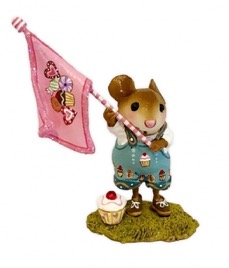
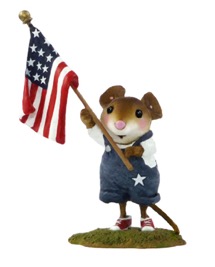
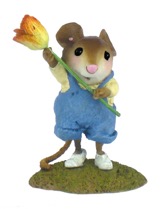
Consider
the Flower Babies boy mouse holding a tulip on the right side of the
lineup below (FB-1). He is basically the same as the regular line
mouse called Homegrown Stars and Stripes (FB-5a), where he is
depicted holding a US flag. Both pieces are in the regular WFF line
and neither is considered an OAK. However, FB5a has been modified
several times by changing the clothing and the flag the mouse is
holding: a pirate flag, a yellow flag with a lion’s head, a floral
flag, a pink flag, and several others. Those other pieces are
considered OAKs not because the mouse has changed significantly (his
hands and feet are in exactly the same place, his facial expression
is the same, and his face has the same shape) but because his
accessory (the flag) and his clothing have changed for just one
piece.
Even
if the face and hands stay the same, a simple change in clothing from
green overalls to a sparkly marching band uniform could make this
same piece an OAK girl mouse holding a baton just as it turned a $54
regular line piece (Mouse) to a $5000 charity auction treasure
(Homegrown Stars and Stripes holding a pink flag covered in sweet
treats and wearing overalls with similar cupcake decorations on a
cupcake base).
Three
different pieces based on FB-1 and FB-5a:
| Confectionary Pride, Fairy Tales OAK |
Regular Line Homegrown Stars & Stripes |
Flower Babies Mouse |
 |
 |
 |
ONE-OF-A-KIND
LEVEL THREE CUT-AND-PASTE OAKS—unique pieces created by changing
elements of the scene composition and/or occupants
Early
WFF pieces were mostly individual mice and other animals sculpted as
the centerpiece of a WFF piece surrounded by various types of
accessories. As a result, at this point in time, the WFF line
contains molds for an incredibly long list of possible scenes that
can be created re-using those accessories: wildlife literally from A
(angelfish) to Z (zebras); a wide variety of animals (dogs,
squirrels, chipmunks, skunks, bunnies, chicks; birds that can be
painted a dozen different ways based on size and shape; flowers and
plants including cacti and a Venus Flytrap) in every possible color;
and even fish and a bat ray.
Also
useful for creating pieces would be furniture used in WFF designs,
vehicles (including pick-up trucks, cars, airplanes, motorcycles, and
even hot air balloons), and the wide range of other accessories
(baskets, sporting equipment, beach gear, sleds, skis, toys,
strollers, musical equipment and much, much more). And, of course,
the wide variety of bases that have been created over the years offer
many starting places for setting the scene for an OAK (tiled interior
floors, flower gardens, sandy beaches, beaches covered in shells and
sea glass, rocks, wood, grass, rugs, circus rings, and even a flying
magic carpet).
Once
an idea is conceived, there are scores of ways that idea can be
brought to life by repurposing items from other WFF pieces already in
the line. If the resultant WFF pieces are made only once, they are
OAKs regardless of how many previous pieces contributed to the
overall design.
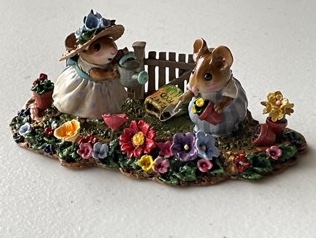
For
example, Mom's Garden pictured below is an event piece created for
Folktoberfest. It does not appear in any WFF catalog because it was
offered for sale only in conjunction with Folktoberfest and appeared
in promotional literature for that event. In the Master List it is
named and numbered as a Folktoberfest event special, and at least 125
of these pieces were made and sold. It is definitely not an OAK.
Key
elements in this piece are two mice (Mom wearing a floral sunhat
holding a watering can and child holding a potted plant), a fence, a
bag of plant food, some flower pots on the ground, and numerous
ground flowers in a variety of bright colors.
Mom's
Garden
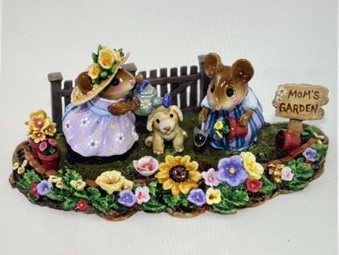
A
gift piece was created by the Factory based on the elements of the
original piece and only one of this gift WFF was created. The
revised version contains the same two mice located in the same
positions but they are dressed differently. The bag of plant food is
gone and between them sits a small dog (that happens to be a match
for the owner's actual dog). To the right a sign announcing "MOM'S
GARDEN" has replaced one of the flower pots from the original piece
(and that pot was moved behind Mom). All of the flowers on the
ground are now painted in colors that are different from how they
appear on the event piece. No other changed version of Mom's
Garden exists, making it a very desirable, treasured CUT-AND-PASTE
OAK because the changes are significant and only one of these was
made. It will never be repeated.
Cut-and-Paste
Transformation
There
are numerous examples of this type of OAK piece, in large part
because Mouse Expo, Fairy Tales, Folktoberfest, and store events were
given the opportunity to run charity auctions with special pieces
sent directly from WFF as OAKs for that purpose. Many of those
pieces are considered cut-and-paste changes but, when only one exists
in some specific altered version, that piece is a CUT-AND-PASTE OAK.
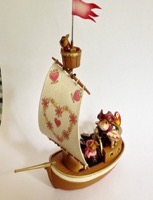
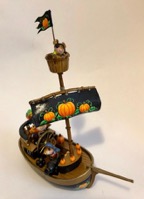
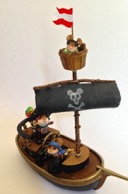
Pictured
below is a mash-up between two different types of
watercraft: Breezing Along (a sailboat), a piece in the regular WFF
line that collectors were able to customize (creating OAKs), and
Finding Treasures (a Pirate ship), an event piece created for
Folktoberfest.
 |
 |
 |
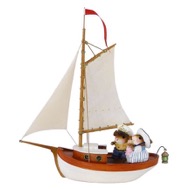 |
| Breezing Along |
Finding Treasures |
Finding Treasures |
Breezing Along |
| Customized Heart Sailboat OAK |
Customized Halloween OAK |
Original Folktoberfest Piece |
Regular Customizable Piece |
Notice
how elements from the regular line and event pieces have been changed
and merged to create the two CUT-AND-PASTE boats: the Customized
Heart Sailboat and the Customized Halloween Pirate Ship.
For
the Heart Sailboat (which was designed to be a custom piece for a
breast cancer charity) the sail from the Pirate Ship was raised and
mounted to a combination of pieces from both the sailboat and the
Pirate Ship. The smallish console holding the Pirate Ship mast at
the front of the boat was replaced by a refitted version of the
console holding the sails for the OAK Breezing Along piece, only
positioned in the back of the boat instead of the front. You can see
the console portholes in front of the mice in Breezing Along and it
is turned around and placed behind the pirate in Finding Treasures,
with the original rail still in place for the parrot.
Clearly
meshing structures from these two very different boats was a feat of
both artistic vision and thoughtful engineering. The resultant Heart
Sailboat earned $5000 for a breast cancer charity and the addition of
pumpkins, a canon with cannonballs, a raven, and a pumpkin flag
converted a $490 event special to a $2000 CUT-AND-PASTE OAK for
another charity.
ONE-OF-A-KIND
LEVEL FOUR COLOR CHANGE OAKs—same piece, different color choices
OAKs
of this type are created when a piece in existence is changed by a
modification of the colors selected for that piece as it originally
appeared in the line. A girl mouse may be transformed to a boy mouse
by simply changing clothing and accessory colors. A University of
Michigan Marching Band (maize and gold) can be disguised as a
Michigan State Marching Band (green and white) with a change of
uniform colors and logos. The pieces in the “new” color are
considered OAKs if only one such piece is painted in those colors.
Ironically,
COLOR CHANGE OAKs may be relatively easy for WFF to make and
simultaneously the most elusive to find. There is no reason for the
Petersens to make one piece in a color different from the regular
line pieces unless it's a gift for a specific purpose or person.
However, that can happen. Annette would sometimes send regular line
pieces painted in different OAK colors to people she knew as goodwill
gifts or Christmas presents or simply gift them to friends at the
factory. Obviously, those OAKs are extremely valuable to the
recipients.
Wouldn't
an OAK Singing Star in lavender or yellow be great??
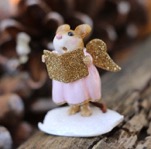
Although
color changes may not seem dramatic, they can, in fact, be
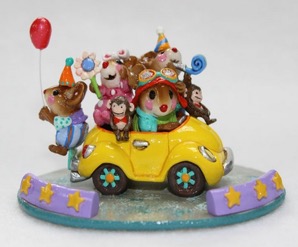
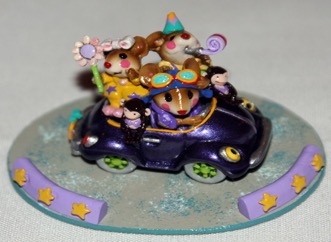
transformative, as in the case of the Clown Car below. The car was
part of a Carnival/Circus-themed Folktoberfest event. The original
color was yellow and a significant number of the pieces were sold
because who doesn't love a Clown Car? Also created for that event
was a color change for that piece which created a stunning purple OAK
in the process.
 |
 |
| Event Special Yellow Clown Car |
OAK Purple Clown Car |
COLOR
CHANGE pieces make up the bulk of sets of pieces that basically are
the same piece with only color as a modification. But, because
scores of those pieces are made for the regular WFF line they are not
OAKs.
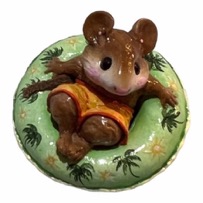
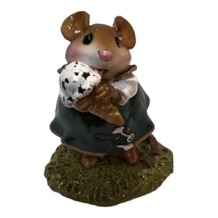
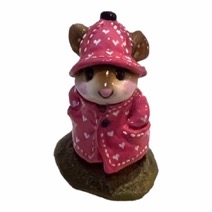
Examples
that can be found in this Master List include Zeldas, April Showers
pieces, Yummys, Sunday Drivers, and Little Devils. Many of these
pieces that have been created in multiple colors also have been
painted as OAK COLOR CHANGE pieces with EMBELLISHMENTS, like the
highly decorated April Showers piece below, the Fun Float that is a
combination of COLOR CHANGE and EMBELLISHMENT, and the Yummy in
unique colors EMBELLISHED with the face of a Cow. These three pieces
go beyond a simple COLOR CHANGE and they are the only pieces painted
in these colors with these embellishments. They are not now and
never were pieces in the official WFF line.
ONE-OF-A-KIND
LEVEL FIVE CUSTOMIZATION AND EMBELLISHMENT OAKS—something for
everyone!
An
extremely popular way of attaining OAK Wee Forest Folk pieces is
through CUSTOMIZATION events either offered by the WFF factory or
obtained at WFF special events like Mouse Expo, Fairy Tales,
Folktoberfest, store events, and Annette's 100th
Birthday Party. Another type OAK occurs when a piece is EMBELLISHED
by a Petersen and/or a WFF painter, another form CUSTOMIZATION.
The
actual CUSTOMIZATION options differ significantly but the idea is the
same: collectors have an opportunity to make decisions about what
the pieces they would like to purchase will look like. The choices
they make differ by event but every customization event piece is a
bona fide
WFF collectible OAK at the end of the process because the probability
any two customized pieces would be exactly the same is slim to none.
Early
on, stores and WFF events were able to invite painters to attend
those events as representatives of WFF. They signed autographs, gave
presentations about various aspects of the production process, taught
attendees how to paint mouse eyes to perfection, and, if attendees
were lucky, they embellished pieces on the spot. At one event
attendees could purchase April Showers in a variety of colors and
guest painters would embellish little sailboats and other small
designs on the pockets. Those sailboat embellishments transformed
regular line pieces into CUSTOMIZATION OAKS. At a Fairy Tales event
attendees could ask to have specific pieces from the Peter Pan set
embellished. At a Folktoberfest event attendees created a fall
accessory piece with dogs, cats, birds, bunnies, rakes, and grass
bases covered in fall leaves. At another Folktoberfest event
attendees selected paint colors for a tiny WFF mouse by chatting
one-on-one with painters on a Zoom call during the event. Mouse Expo
attendees created beautiful fairy pieces from an assortment of
fairies, small creatures, and other bits of decoration on a woodland
base that could also be customized.
Auction
items for events were frequently embellished at the Mouse Factory in
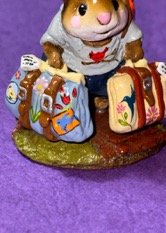
various ways to make pieces unique and OAK. For example, pictured below is Traveling Mouse as he appeared in such an auction at a
WFF-sponsored event. Although the basic colors for his clothing
remain the same as the piece in the regular line, his baggage is
heavily embellished to establish his extensive travel experiences.
The fact those embellishments were added at the Mouse Factory by WFF
painter(s) makes him an EMBELLISHED OAK and significantly increased
value for the charity auction.
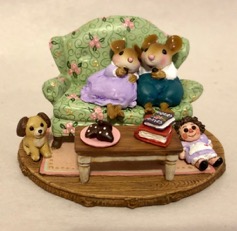
The
beautifully embellished sofa for the Sweet Snuggle piece is an OAK
based on two characteristics: the detailed painting on the sofa and
the substitution of a little dog, brownies, a book, and one of
Annette’s favorite collectibles, a Raggedy Ann doll. Those changes
from the regular line piece plus changed clothing colors (used only
for this WFF) transformed this piece into something that looks
totally different from the
original, making it a factory CUSTOMIZED AND EMBELLISHED OAK.
 |
 |
| Traveling Mouse OAK |
Sweet Snuggle with dog and Raggedy Ann OAK |
One
of the earliest opportunities for customization by the factory was
the creation of a piece called His and Her Creature Comforts. Beds
from the regular WFF line were offered in two colors and collectors
could choose from a list of 25 stuffed animals to position around and
on the bed to create OAK versions of this piece. Everyone who chose
to customize one or both of the beds was able to create wonderfully
imaginative bedroom scenes too complex and unique for any two beds to
turn out exactly the same, giving everyone who participated a
CUSTOMIZED OAK.
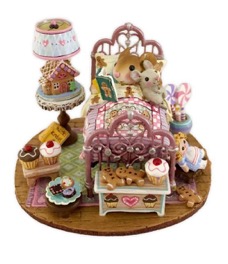
Some
of the WFF events took the experience up a notch by using accessories
not available on the 'regular' order
sheets to create an accessorized bedroom scene, including the piece
pictured below. Instead of stuffed animals, Fairy Tales added to
their 'sweet' theme by using candy and cookies and a Raggedy Ann
doll to accessorize their Her Creature Comforts auction piece, as
well as several embellishments: cupcakes painted on the stool and a
gingerbread quilt with gingerbread sheets, creating an exceptional
CUSTOMIZATION AND EMBELLISHED OAK.
Her Creature Comforts Customized and Embellished
Another
factory-initiated customization piece involved choosing which toys to
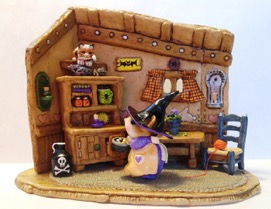
put under a Christmas Tree. A WFF retailer, Small World, held
several customization events over the years during which time
attendees designed several Coaxing Kitty with Kibble rooms and the
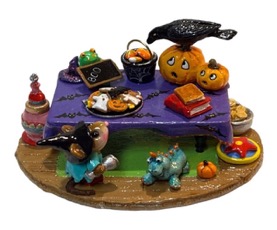
inside of an ice cream shop. Yet another customization allowed
collectors to create their own version of a Halloween table. This
activity was also available at Folktoberfest using a different
Halloween-themed tablecloth and different Halloween items. For both
events participants selected from a page full of items and placed
them inside a scene with a trick-or-treater mouse holding a
flashlight, creating CUSTOMIZATION OAKs.
 |
 |
| Folktoberfest Halloween Table |
Old World Wee Mousey's Coaxing Kitty with Kibble Room |
Many
many OAKs in existence are the result of customization opportunities.
The Breezing Along sailboat discussed earlier was able to be
customized; every WFF event and many stores have offered
customization opportunities. However, some of the most special
customized pieces were created at Annette's 100th
Birthday Party.
Everything
about the Birthday Party was special, but the activities that ended
with party goers creating special OAKS were exceptional.
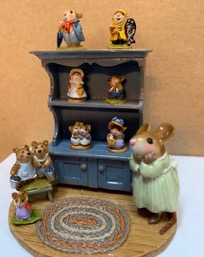
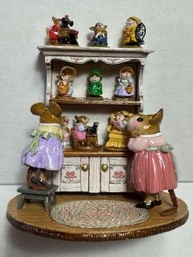
For
starters attendees could select WFF minis available ONLY during the
event to place in curio cabinets painted in colors only available at
the event. Both those minis and the special color cabinet retired on
the last day of the event, making their entire time in the line just
3 days. Attendees could choose cabinet color, which minis they
wanted to use, which regular size mice to put in front of the curio
cabinet and where to place the minis and the larger mice in the
scene. The number of minis available times 3 colors of cabinets,
multiple colors for both the Momma Mouse and the child mouse, the
inclusion or exclusion of the stool, and at least 15 possible
locations for the minis and a half dozen places to locate the larger
mice is the equation for figuring out how many possible OAK pieces
could be made. The likelihood that every design is an OAK is very
high.
 |
 |
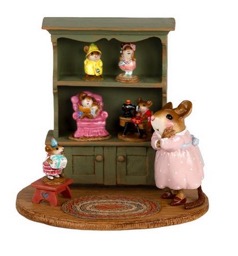 |
| Special Minis in a blue Curio Cabinet |
Grand Prize Curio Cabinet designed by the Factory |
Special Minis in a green Curio Cabinet |
Attendees
also were able to create embellishment choices for Icing on the Cake
from a wide range of possible embellishments, as well as ideas from
their own imaginations: Raggedy Ann dolls on pockets, elaborate
floral arrangements on aprons, candles on the cake, mouse faces on
the cake and apron pockets, and writing on the cakes, and, no doubt,
much more.
Icing
on the Cake has also been used as OAK specials for other WFF events.
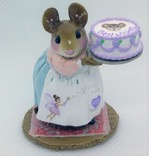
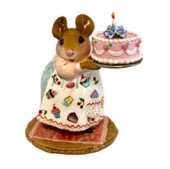
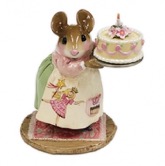
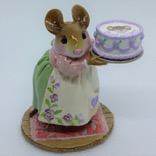
Icing
on the Cake Variables:
Cake color (yellow, strawberry, chocolate, white), cake frosting
colors, decoration on top of cake (candles, words, mouse face)
clothing colors, clothing embellishments, pocket embellishments,
apron embellishments
ONE-OF-A-KIND
LEVEL SIX MISTAKE PIECES—accidental differences
Handmade
items are wonderful because, well, they are made by hand: no
assembly lines, no machine-applied decorations, no 3-D printed
components. When something goes ever so slightly 'wrong' with a
handmade item, that enhancement can be a pleasant surprise.
What
can go wrong? For example, a painter may pick up the wrong shade of
pink for hair ribbons. Or maybe an embellishment is supposed to be a
heart on a pocket but the painter draws a flower instead. Or perhaps
a bird that should have been painted as a crow is accidentally turned
into a cardinal or a bluejay. Mistakes happen. And, when they do,
they create accidental OAKs that are sought-after by collectors who
treasure these OAK 'mistakes' as much as deliberately customized
pieces.
Of
course, photographs of mistake pieces are difficult to locate because
often mistake collectors keep the pieces they find a secret AND
because, quite frankly, WFF painters rarely make mistakes.
In
the small number of circumstances when they do, the finishers at WFF
almost always catch and repair mistakes before they leave the
factory. But, then again, nobody is perfect...
CONCLUSION
Another
essay in this series talks about types of Collectors. Some want them
all. Some select pieces that evoke memories. Some use WFF pieces as
actors in scenes and others go a bit further and place WFF pieces
into dollhouses to 'live their mousey lives'. The types of
Collectors discussed did not include those who seek out the rare and
special pieces because wanting something rare just might be a
universal trait for Collectors of all things. Wanting 'one of
each' does not preclude wanting 'something rare and wonderful'.
There
are many ways to acquire OAK Wee Forest Folk and not all of them
require spending thousands of dollars. The trick is to stay engaged
and aware. Page through this Master List and take note of all the
OAK pieces listed here. You'll be surprised.
Take
advantage of customization opportunities sponsored by WFF. You can
rest assured that the end result of your decision-making will be
something rare and wonderful.
Communicate
with other WFF Collectors in person if you can. Do other WFF
Collectors live near you? Maybe set up a meet-and-greet lunch to
make new friends who share your love for the WFFs?
Do
you follow the Official Wee Forest Folk Facebook page and their web
page? Don't miss an opportunity to participate in a customization
activity if the Factory releases a piece you can customize. Do you
follow other social media sources of information such as The WFF
Museum announcements, the WFFCC web page and Facebook pages, store
websites, and selling sites like Amazon and eBay? Collectors do
offer OAK pieces for sale sometimes.
In
short, the opportunities are there. If you'd like to add one or
more OAKs to your collection, be ready to take advantage of an
opportunity when you find one.